The adaptive operating-model platform
One operating model.Every tool.
Weaveplane turns an approved way of working into roles, rhythms, controls, and integration policies—then keeps execution evidence connected as reality changes.
One product story · A useful path for you
What are you here to evaluate?
Choose now. The shared product and evidence remain identical; only the final three questions adapt to your perspective.
The audience control stays in the header, so you can switch paths later without scrolling back or losing your current slide.
The alignment break
The decision is made once. Work changes everywhere.
Teams approve how an initiative should run, then distribute its pieces across systems that cannot preserve the whole.
The symptoms arrive before the failure
The mess looks ordinary—until a decision matters.
The model is clear at the beginning.
Each system keeps only its native facts.
Capacity, ownership, dependencies, and timing move.
Meetings and spreadsheets reconstruct context.
Evidence cannot explain whether change was deliberate.
First-hand practitioner observation
Four organizations. The same setup gap.
Across four organizations, I saw teams begin delivery before a usable operating model was in place. The basics—what meetings to run, what each meeting needed, who owned each decision, and what outputs were expected—were still being worked out.
The broader operating-model effort remained unfinished for as long as two years in one organization and four months in another. Getting the immediate project setup running took 3–4 weeks, while teams agreed the meeting structure, accountabilities, and expected outputs.
First-hand practitioner observation across four organizations, recalled retrospectively by a single participant and not independently verified. It is the reason this product exists. It is not proof of a market.
The consultant objection
A document still needs an adoption mechanism.
In one recalled organization, outside specialists were engaged, but a working operating model still did not emerge. That incident motivates a question; it does not establish how consulting engagements perform in general.
Document-led operating-model work may remain dependent on internal ownership, translation, and adoption after a specialist engagement ends. Weaveplane is designed to test whether provisioning into everyday work reduces that adoption risk.
The difference here is not a better document. The design provisions the compiled model into the tools where work already lives: the pages exist, the meeting series is in the calendar, and the accountabilities are attached to real people. That provisioning is specified, not implemented.
Practitioner hypothesis based on one retrospectively recalled incident from a single participant; not independently verified and not general evidence about consultants. Provisioning is designed and specified. It is not yet built.
Documented context · untested trigger
The condition is documented. The trigger is what I am here to test.
Curated evidence register · six independent signals · reviewed 25 July 2026. New claims enter only after source, method, relevance, and limitation review.
A new responsibility—not another workspace
Tools record pieces. Weaveplane preserves the model.
Every execution category stays authoritative for its native facts. Weaveplane becomes the source of truth for how those facts should fit together.
Interprets Status · ownership · dependencies against the approved operating model.
Category examples show the intended ecosystem. They do not claim every named provider is already connected.
The product sits above execution—not inside it
Evidence comes in. Approved intent goes back.
Select a category to trace the exact authority boundary. The active path animates; the operating rule stays explicit.
Exists todayworking product · demonstration data
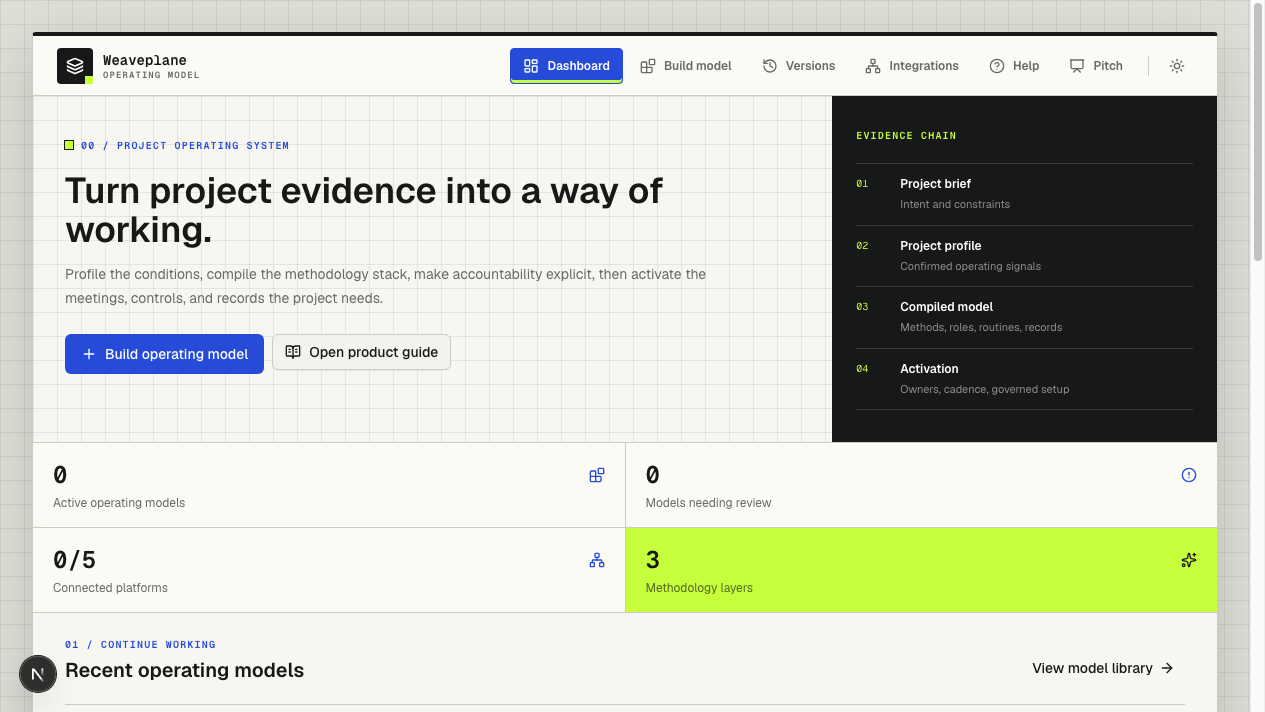
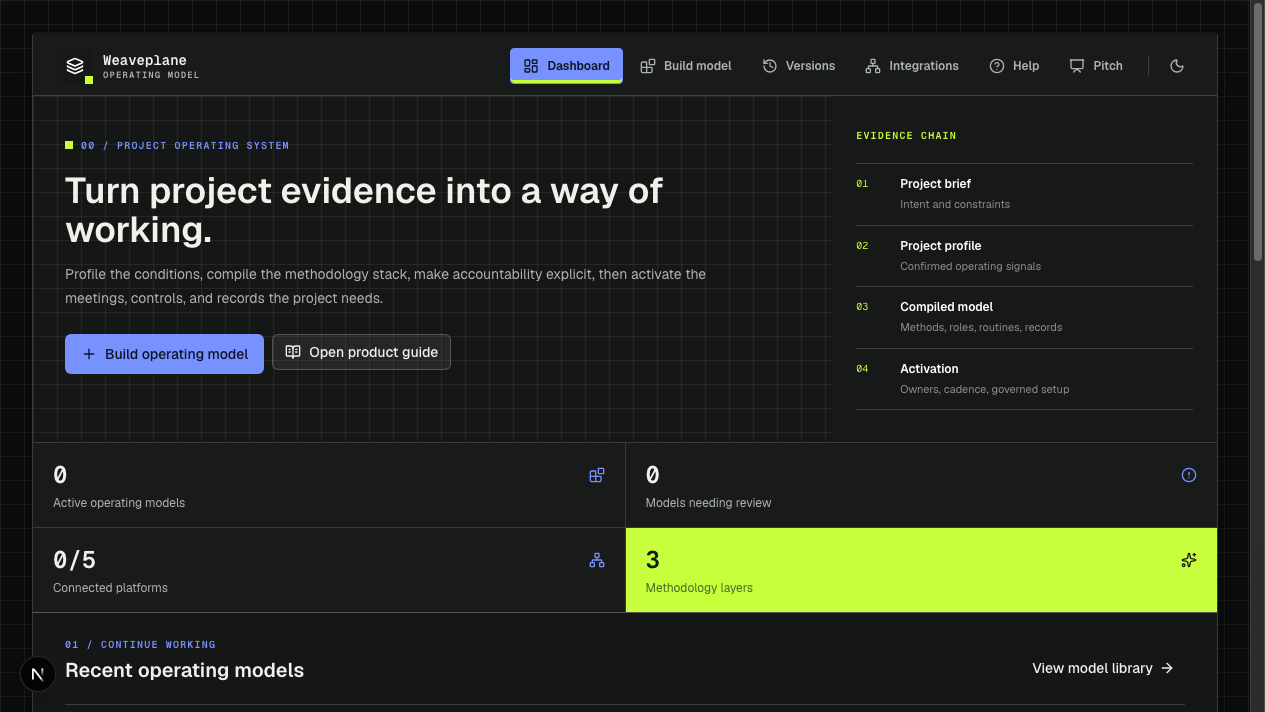
See the operating estate.
Operating models, review state, connection readiness, and methodology layers are visible in one place.
View 1 of 3: Command centre.
On smaller screens, focus this screenshot and use the arrow keys or swipe to inspect it.
Adopt · Adapt · Build
Choose the path. Keep approval human.
The hierarchy stays stable; the selected journey shows what the team must reuse, tailor, or author before operating intent can become an approved version.
Adopt path selected. Existing organization policies, asset and project execution models flow into a project-specific model, then stop at a human approval gate before an approved version.
Select the governed organization model, bind it to the project, and submit that operating intent for human approval.
Exists todayGoverned Model Studio, version review, and approval lifecycle. Later gateProvider login, signed webhooks, and outbound provider actions are unimplemented; SAR-42 and SAR-44 gate that future work.
Product truth before product promise
A V4 feedback alpha—with visible security gates.
The public product is the V4 feedback alpha. It demonstrates the governed model workflow without claiming production accounts, tenant isolation, or live provider credentials.
- Public V4 feedback alpha
- Context-to-model compilation
- Governed Model Studio and human review lifecycle
- Command centre and integration boundary
- Supabase Frankfurt (EU, eu-central-1) with row-level security
- Sentry EU project configured; request bodies, user details, and AI inputs and outputs excluded
- Accounts and multi-tenant isolation — later gate
- Provider login and credentials — not implemented
- Signed webhooks and replay protection — specified after the tenant-security gate
- Outbound provider actions — not implemented and remain approval-gated
- Urgent buyer and triggering moment
- Measurable pilot outcome
- Willingness to pay and expansion logic
- Category language customers recognize
A concrete trigger—not a platform migration
Start when the way of working must change without losing control.
More teams join one initiative.
Decision rights and handoffs move.
Evidence must match the approved process.
The method changes while delivery continues.
One initiative · Two evidence surfaces · One decision loop
Prove value before expanding authority.
Capture the approved way of working.
Read evidence from two system categories.
Surface one meaningful divergence.
Decide whether the model or execution changes.
Review clarity, adoption, and change lead time.
Pilot measures are proposed success criteria—not claimed customer outcomes.
A pilot earns expansion with evidence
Measure the operating decision—not screen time.
Can each role explain the current operating rule?
Can a change be followed from evidence to approval?
How much manual cross-tool checking is removed?
How quickly can a meaningful drift be resolved?
Your customer path
Choose one process worth aligning.
A useful first conversation identifies one live initiative, two evidence surfaces, and one operating decision worth making traceable.